Insecure Deserialization
Serialization is the process of turning some object into a data format that can be restored later. People often serialize objects in order to save them to storage, or to send as part of communications. Deserialization is the reverse of that process -- taking data structured from some format, and rebuilding it into an object.
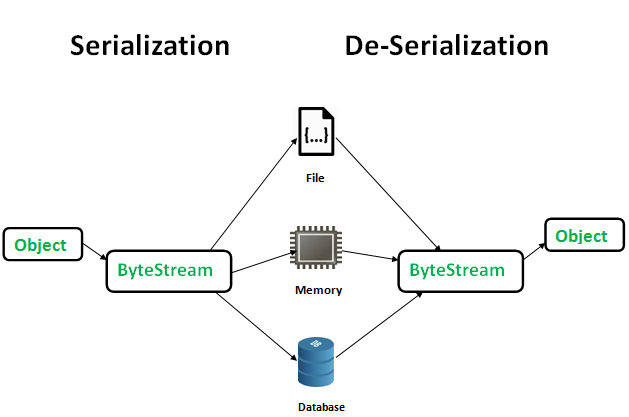
Deserialization Identifier
| Object Type | Header (Hex) | Header (Base64) | Indicators |
|---|---|---|---|
| .NET ViewState | FF 01 | /w | Commonly found inside hidden inputs around HTML forms |
| BinaryFormatter | 0001 0000 00FF FFFF FF01 | AAEAAAD | Base64 decode and check for the long FF FF FF FF sequence. |
| Java Serialized | AC ED | rO | Base64 decode and check first bytes. |
| PHP Serialized | 4F 3A | Tz | Prefixes like O:, a:, s:, i:, b: and length indicators. |
| Python Pickle | 80 04 95 | gASV | Text: opcodes like (lp0, S'Test'. |
| Ruby Marshal | 04 08 | BAgK | Base64 decode and look for \x04\x08 at the start. |
POP Gadgets
A POP (Property Oriented Programming) gadget is a piece of code implemented by an application's class, that can be called during the deserialization process.
POP gadgets characteristics:
- Can be serialized
- Has public/accessible properties
- Implements specific vulnerable methods
- Has access to other "callable" classes