Cross Site Request Forgery (CSRF)
Cross-site request forgery (also known as CSRF) is a web security vulnerability that allows an attacker to induce users to perform actions that they do not intend to perform. It allows an attacker to partly circumvent the same origin policy, which is designed to prevent different websites from interfering with each other.
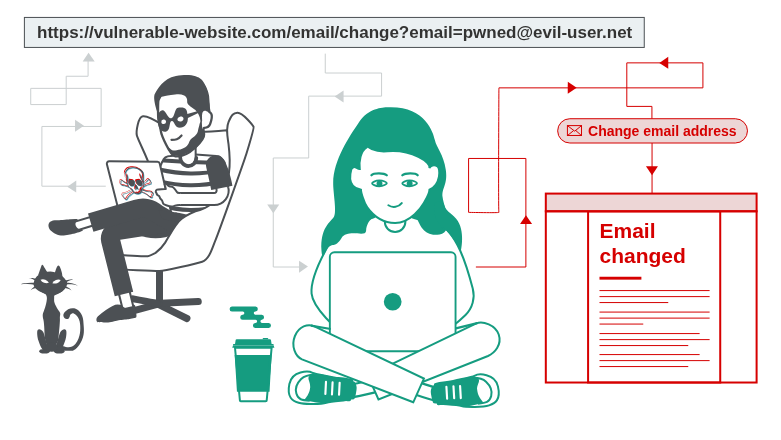
How does CSRF work?
For a CSRF attack to be possible, three key conditions must be in place:
- A relevant action. There is an action within the application that the attacker has a reason to induce. This might be a privileged action (such as modifying permissions for other users) or any action on user-specific data (such as changing the user's own password).
- Cookie-based session handling. Performing the action involves issuing one or more HTTP requests, and the application relies solely on session cookies to identify the user who has made the requests. There is no other mechanism in place for tracking sessions or validating user requests.
- No unpredictable request parameters. The requests that perform the action do not contain any parameters whose values the attacker cannot determine or guess. For example, when causing a user to change their password, the function is not vulnerable if an attacker needs to know the value of the existing password.
For example, suppose an application contains a function that lets the user change the email address on their account. When a user performs this action, they make an HTTP request like the following:
POST /email/change HTTP/1.1
Host: vulnerable-website.com
Content-Type: application/x-www-form-urlencoded
Content-Length: 30
Cookie: session=yvthwsztyeQkAPzeQ5gHgTvlyxHfsAfE

email=wiener@normal-user.com
This meets the conditions required for CSRF:
- The action of changing the email address on a user's account is of interest to an attacker. Following this action, the attacker will typically be able to trigger a password reset and take full control of the user's account.
- The application uses a session cookie to identify which user issued the request. There are no other tokens or mechanisms in place to track user sessions.
- The attacker can easily determine the values of the request parameters that are needed to perform the action.
With these conditions in place, the attacker can construct a web page containing the following HTML:
<html>
    <body>
        <form action="https://vulnerable-website.com/email/change" method="POST">
            <input type="hidden" name="email" value="pwned@evil-user.net" />
        </form>
        <script>
            document.forms[0].submit();
        </script>
    </body>
</html>
If a victim user visits the attacker's web page, the following will happen:
- The attacker's page will trigger an HTTP request to the vulnerable website.
- If the user is logged in to the vulnerable website, their browser will automatically include their session cookie in the request (assuming SameSite cookies are not being used).
- The vulnerable website will process the request in the normal way, treat it as having been made by the victim user, and change their email address.
How to construct a CSRF attack
Manually creating the HTML needed for a CSRF exploit can be cumbersome, particularly where the desired request contains a large number of parameters, or there are other quirks in the request. The easiest way to construct a CSRF exploit is using the CSRF PoC generator that is built in to Burp Suite:
- Select a request anywhere in Burp Suite that you want to test or exploit.
- From the right-click context menu, select
Engagement tools > Generate CSRF PoC. - Burp Suite will generate some HTML that will trigger the selected request (minus cookies, which will be added automatically by the victim's browser).
- You can tweak various options in the CSRF PoC generator to fine-tune aspects of the attack. You might need to do this in some unusual situations to deal with quirky features of requests.
- Copy the generated HTML into a web page and host it, view it in a browser that is logged in to the vulnerable website, and test whether the intended request is issued successfully and the desired action occurs.
How to deliver a CSRF exploit
The delivery mechanisms for cross-site request forgery attacks are essentially the same as for reflected XSS. Typically, the attacker will place the malicious HTML onto a website that they control, and then induce victims to visit that website. This might be done by feeding the user a link to the website, via an email or social media message. Or if the attack is placed into a popular website (for example, in a user comment), they might just wait for users to visit the website.
Note that some simple CSRF exploits employ the GET method and can be fully self-contained with a single URL on the vulnerable website. In this situation, the attacker may not need to employ an external site, and can directly feed victims a malicious URL on the vulnerable domain. In the preceding example, if the request to change email address can be performed with the GET method, then a self-contained attack would look like this:
<img src="https://vulnerable-website.com/email/change?email=pwned@evil-user.net">